.webp)


Why Unplugging From Technology Matters and How Board Games Can Reconnect Your Family

The Quiet Cost of Constant Connection
Technology is woven into nearly every hour of our lives. We wake up to it, work through it, relax with it and often fall asleep beside it. It helps us navigate traffic, track our health, message friends and access entertainment instantly. But for all this connection, something feels off.
Worldwide, 1 in 6 people report experiencing loneliness. Social media use continues to rise, yet in-person interaction is declining. Children are spending more time on devices and less time outdoors. Teens report being online constantly. Adults speak openly about burnout, anxiety and digital overwhelm.
Global Day of Unplugging exists for a reason. It is not anti-technology. It is pro-balance.
When screens dominate our days, we can begin to lose something simple but essential: real human connection, focused attention and the ability to sit comfortably in the present moment.

Children and Screen Dependency
Studies have shown that by age two, a significant percentage of children already have access to their own tablets. By five, that number increases further. Research has also linked excessive screen exposure in early childhood with slowed development of white matter in the brain, which plays an important role in language development and learning.
As children grow, smartphone use has been associated with sleep disruption, reduced physical activity and increased exposure to content that many parents would prefer to delay which raises more concerns.
Teens and Online Risk
Recent surveys suggest that nearly half of teenagers describe themselves as being online “almost constantly.” Many report they have been exposed to explicit content on their devices during school hours. There has also been a troubling rise in online exploitation, including sextortion cases targeting young people.
These are not isolated stories. They reflect a broader reality: digital life moves faster than our ability to regulate it.
Adults and Digital Overload
The impact is not limited to young people. Adolescents and young adults report daily social media use at near universal levels. Mental health concerns have increased across all age groups and many young adults express uncertainty around employment, social confidence and future milestones.
Technology is not the sole cause of these issues, but constant connectivity can amplify stress, comparison and cognitive fatigue.
The AI Acceleration
On top of all of this Artificial intelligence is now embedded in everyday tools. In just a few years, weekly AI users have grown from around 100 million to hundreds of millions globally. While AI offers incredible efficiency, some research suggests heavy reliance on chatbots may correlate with increased loneliness and reduced real-world socialisation. Again, this is not about fear. It is about boundaries.
When we outsource too much thinking, decision-making or companionship to screens, our brains and relationships can quietly weaken.
That is where unplugging becomes powerful.

What Happens When You Take a Break From Screens?
Many people ask, “What actually changes if I unplug?” The answer is more than you might expect.
Improved Mental Clarity
When you step away from constant notifications, scrolling and digital stimulation, your brain shifts from a high-alert state into something calmer. Cognitive overload decreases. Focus improves. Creativity returns.
Your attention is no longer split across multiple inputs so it can rest.
Better Mood and Reduced Anxiety
Social media comparison, rapid content consumption and dopamine-driven apps can leave the nervous system overstimulated. Taking breaks lowers stress hormones like cortisol and interrupts the cycle of constant stimulation. People often report feeling lighter after even a short digital detox.
Deeper Sleep
Blue light given out by electronic devices from their screens suppresses melatonin, the hormone that signals to your body that it is time to sleep. Reducing screen time before bed allows your circadian rhythm to stabilise. Better sleep supports emotional regulation, resilience and overall wellbeing.
Stronger Attention Span
When we constantly switch between apps, messages and videos, our ability to focus for extended periods declines. Time away from screens allows the brain to restore its attention resources.
Unplugging is not about rejecting modern life. It is about giving your brain the conditions it needs to function well.
The Best Screen-Free Activities for Families

If you decide to reduce screen time, the next question becomes practical: What do we do instead?
Families can build blanket forts and turn living rooms into storytelling castles. You can run kitchen science experiments, bake bread together or organise scavenger hunts. You might explore the countryside, camp in the garden or spend the afternoon at the beach. On rainy days, crafting, baking and creative projects fill the gap beautifully.
But there is one activity that consistently brings people back to the same table, week after week.
board games.
Why Board Games Are Good for Mental Health
I have been involved in tabletop gaming for nearly twenty years. For me, it has never just been entertainment. It has been an anchor. Board games offer something screens rarely do: structured focus.
When you sit down to play, your attention narrows to the present moment. You are not juggling notifications or background noise. You are thinking about your next move. The board becomes the centre of attention. The rest of the world quietens.
That structured rhythm creates a sense of calm. You do not need to worry about every possibility in life, only what is happening within the game. There is also something grounding about physical components. Shuffling cards, moving playing pieces and rolling dice. It engages your senses in a way that feels tangible and real.
Most importantly, board games create face-to-face social interaction. The game itself acts as a shared focal point. Conversation flows naturally with laughter breaking tension. Even quiet players are included because the rules guide participation.
This is one of the reasons we run clubs and events as a business. People are not just looking for something to play. They are looking for somewhere to belong.

Do Board Games Help Children Develop Important Skills?
Yes, and this is one of the strongest arguments for introducing board games into family life.
Board games help children develop:
Problem-solving skills
Patience through turn-taking
Communication and teamwork
Literacy and numeracy
Strategic thinking
Memory and critical reasoning
They also support emotional regulation. Games provide a safe space to experience frustration, disappointment and victory as well as loss. Children learn to handle winning and losing whilst also getting to practise empathy and resilience all key things they need to learn as they grow.
All of this happens through play, which makes the learning natural rather than forced.
Can Board Games Replace Digital Entertainment?
For many people including myself, they already have.
Digital games provide quick rewards: levelling up, unlocking items, progressing through a storyline.
Board games provide layered rewards: discovering new strategies, experimenting with different paths to victory and sharing those moments with other people in real time.
Games like Carcassonne offer simple rules with deep replayability. Whilst cooperative experiences such as The Mind create engagement through shared tension. Story-driven adventures like Star Wars: Imperial Assault allow players to build characters and experience evolving campaigns together replacing all the quick rewards digital games offer.
Unlike many digital experiences, tabletop games are not solitary most of the time. They create shared memories. When you see the box on the shelf months later, you remember that night.
That is hard to replicate with a scrolling feed.

How to Start a Screen-Free Game Night
If you want to reduce screen time without conflict, start small and keep it positive.
1. Set Clear Device Boundaries
Phones can go in another room or stay in pockets. The key is removing them from the table.
2. Set Expectations
Let children and teens know how long the game will take. Clear communication reduces resistance.
3. Choose the Right First Game
Start with something under 30 minutes that is easy to teach and quick to replay.
4. Make It Collaborative
Invite everyone to choose snacks, help set up and even select the game. When people feel involved, they feel invested.
5. Build a Rhythm
If it goes well, make it weekly or monthly. A set time each month or week creates anticipation.
The goal is not to make unplugging feel like punishment. It should feel like something to look forward to.
Beginner Board Games for Unplugging
If you are new to modern board games, the sheer number of options can feel overwhelming. The key when starting a screen-free game night is to choose games that are easy to teach, quick to set up and engaging enough that people ask to play again.
Below are a few beginner-friendly games we regularly recommend, along with what makes each one special.
Family-Friendly Board Games (Under 30 Minutes)

If you want laughter within the first five minutes, this is it.
Ghost Blitz is a fast-paced reaction game built around five wooden objects placed in the centre of the table. Each card shows two objects in different colours, and players must grab the correct object before anyone else. Sometimes you grab what matches. Sometimes you grab what does not appear at all. That twist keeps everyone alert.
What it offers:
Sharpens observation skills
Encourages quick thinking
Gets everyone physically involved
Creates energetic, memorable moments
It is simple to explain, plays in short bursts and works brilliantly across mixed age groups one I really enjoy playing with my family when we get together.
Qwirkle feels familiar in the best way. Think of it as a mix between dominoes and Scrabble, but with colours and shapes instead of letters.
In the game players build lines of matching colours or shapes to score points in a central shared play area. The rules are straightforward, but the strategy develops naturally as players begin spotting patterns and planning ahead.
What it offers:
Develops pattern recognition
Encourages forward planning
Builds numeracy and spatial awareness
Works just as well for adults as children
The travel edition is particularly useful for holidays or café visits, making it a great “take anywhere” unplugging option. This one is one me and Emily enjoy taking on picnic's due to its chilled gameplay.
Ready to turn your table into a giant detective scene?
If you love things like Where's Wally you will love this. Players work together using a large illustrated city map filled with tiny characters and hidden stories. Each case asks you to track a character’s movements across the map to solve a mystery.
What it offers:
Cooperative problem solving
Deductive reasoning
Close observation skills
Shared storytelling moments
Because it is cooperative, it removes competitive pressure. Families work together to solve the mystery, which makes it especially good for building teamwork skills. We really enjoy this game as it is easy to pick up and put down as you explore each case at your own pace.
Beginner-Friendly Games for Adult Groups
If you are hosting friends and family who are new to board games, the goal is to find something that sparks conversation without requiring a rulebook seminar.
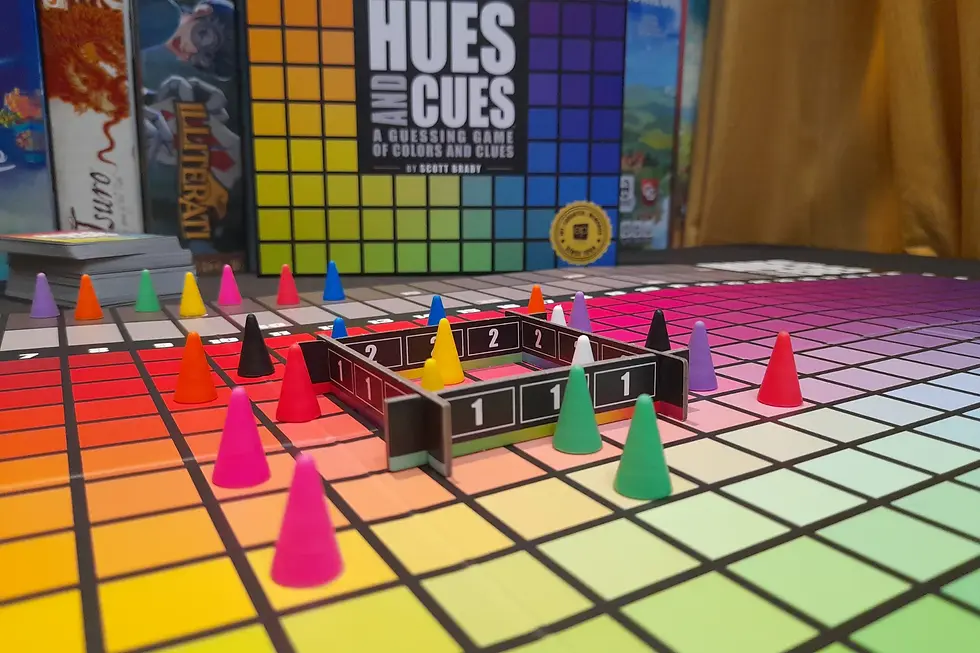
This is a surprisingly clever communication game.
One player gives a one or two word clue describing a specific colour on a massive colour grid. Everyone else tries to place their marker as close as possible to the intended shade. The interesting part? Words mean different things to different people. “Ocean” might mean deep navy to one person and bright turquoise to another making this game more challenging than you first thought.
What it offers:
Lively discussion
Creative thinking
Minimal rules overhead
Plenty of replayability
It works well because it feels light and inclusive, yet still creates competitive fun. This one has been a joy to play with both friends and family and our guests at our board game events due to the table talk it brings around the table.
Often described as a modern classic, Carcassonne is built around placing landscape tiles to form cities, roads and monasteries.
On your turn, you place a tile and optionally deploy one of your wooden followers to score points. The rules are simple enough to learn in minutes, but the strategy unfolds over time as players compete for control of key areas.
What it offers:
Tactical decision making
Gentle strategy without intimidation
Visually evolving play area
High replay value
It is one of those games that grows with a group. You can keep it simple or add expansions as confidence increases to shake things up. This was one of the earliest games in our collection and is still a staple that we use to show people what board games can offer as well as introduce them to the hobby as it is light and accessible with a nice amount of strategy.
The Mind is unlike most games people have played before.
Each player receives a number of cards equal to the round. Then the group must play them in ascending order without speaking. No signals. No planning. Just intuition. At first it feels impossible. Then something shifts, you begin to sense timing. The group synchronises in surprising ways to beat level after level.
What it offers:
Deep cooperation
Heightened awareness
Shared tension and release
Memorable “how did we do that?” moments
It is simple, but it creates a powerful shared experience that often becomes the highlight of the evening. This one holds a special place in my collection as it reminds me of a great evening of shared laughs and fun that we had at a board game convention with friends.
Choosing the Right Game for Your Group
When starting out, ask three questions:
How long do we want to play?
Do we want to compete or cooperate?
Are we looking for high energy or thoughtful strategy?
The right game can transform a screen-free evening from an obligation into something people actively look forward to. And that is the real goal.
Unplugging works best when the alternative is not just “less screen time,” but something genuinely engaging, social and worth gathering around a table for.
Reducing Screen Time Without Arguments

If you are wondering how to reduce screen time for kids or teens without constant friction, start with a conversation. Explain why you value screen-free time and listen to their perspective. Begin with small boundaries rather than sweeping changes.
Frame game night as something positive. A shared experience, a break from noise and a space where everyone is present. When unplugging feels like an invitation rather than a restriction, people are far more likely to embrace it.
A Final Thought
Breaks from technology do not have to be dull. They can become the highlight of the week.
Unplugging is not about rejecting modern tools. It is about reclaiming attention, connection and joy.
Board games offer something beautifully simple: a table, a set of rules and the chance to look at the people around you instead of down at a screen.
And sometimes, that is exactly what we need.
You can find out more about each of the games in this article below:
Frequently Asked Questions About Unplugging From Technology and Board Games
What is the Global Day of Unplugging?
Global Day of Unplugging is an annual event that encourages people to take a 24-hour break from digital devices. It usually takes place in early March. The idea is simple: step away from screens and reconnect with real-world activities, people and surroundings. It is not about rejecting technology entirely, but about creating space for balance.
Why is reducing screen time important?
Excessive screen time has been linked to sleep disruption, reduced attention span, increased anxiety and lower physical activity. For children and teenagers, heavy device use can also affect learning, emotional regulation and social development.
Reducing screen time gives the brain a chance to recover from constant stimulation. It also creates opportunities for face-to-face interaction, which supports mental health and long-term wellbeing.
What happens when you unplug from technology?
Many people notice improved focus within a few days of reducing screen use. Sleep quality often improves when devices are removed from bedtime routines. Mood can stabilise because there is less exposure to social comparison and digital overwhelm.
Even the smallest changes, such as a weekly screen-free evening, can reduce stress and restore a sense of calm.
How do board games help reduce screen time?
Board games offer a structured alternative to digital entertainment. Instead of scrolling or gaming alone, players sit around a table and interact directly with one another. Because games provide challenge, strategy and shared goals, they hold attention naturally. This makes it easier to put devices away without feeling bored.
Are board games good for mental health?
Yes they are. Board games can support mental health by encouraging focus, mindfulness and social interaction. Playing games helps people concentrate on the present moment rather than worrying about external stressors that surround them.
They also create positive social experiences, which are strongly linked to improved mood and reduced feelings of loneliness.
Do board games help children develop skills?
There are many ways board games help children such as assisting them with practicing problem-solving, patience, communication and decision-making. Many games also support literacy, numeracy and memory skills. Just as importantly, games teach emotional resilience. Children learn how to cope with losing, celebrate winning appropriately and collaborate with others which are all valuable life skills.
Can board games replace video games?
For many families, board games do not completely replace digital entertainment, but they reduce reliance on it. Tabletop games provide depth, replayability and shared experiences that screens cannot fully replicate. Because they involve face-to-face interaction, they often feel more meaningful and memorable.
How do I start a screen-free family game night?
Start small. Choose one evening and set clear device boundaries. Let everyone know how long the game will last and involve them in choosing snacks or selecting the game. Pick something easy to learn and under 30 minutes for your first session. The goal is enjoyment, not perfection. If it goes well, turn it into a regular tradition.
How can I reduce screen time without arguments?
Open conversation works better than strict rules. Explain why screen-free time matters to you and listen to others’ views. A gradual change is usually more successful than sudden restrictions. Frame unplugging as a shared activity rather than a punishment. When people feel included in the decision, resistance decreases.
What are the best beginner board games for unplugging?
Look for games that are quick to teach, have minimal setup and play in under 45 minutes.
Family-friendly options include:
Ghost Blitz
Qwirkle
For adult groups:
Carcassonne
The Mind
The right choice depends on whether your group prefers fast-paced energy, quiet strategy or cooperative teamwork be sure to discuss options with your group and pick a game that people get excited about. The rule of cool wins.
Is unplugging realistic in modern life?
Completely disconnecting long term may not be practical for most people. However, intentional breaks are realistic and sustainable. Even one tech-free evening per week can improve focus, sleep and connection. The goal is not elimination. It is balance.


Comments